How to Display a Book Nook: Shelf Styling & Setup Guide
BookNookKit.diy Editorial Team
Updated June 29, 2026 · 6 min read · 40+ kits researched
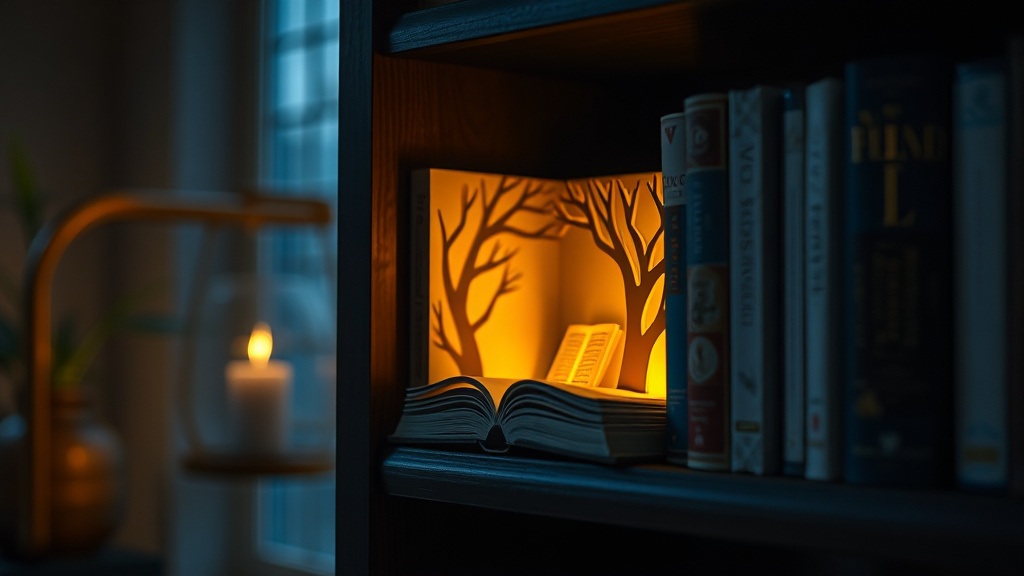
You've built your book nook. Now comes the part most guides skip: making it look as good on your shelf as it does in your head. Placement, book arrangement, lighting setup and a few styling choices make the difference between a nook that stops visitors mid-sentence and one that blends into the background.
Where on your shelf does a book nook look best?
Eye level is always the sweet spot. The LED glow and forced-perspective depth of a book nook are designed to be viewed straight on — looking slightly down at a bottom-shelf nook or up at a top-shelf one reduces the illusion. In a typical standing room, eye level is somewhere around 150–165 cm from the floor.
A few other placement principles worth knowing:
- Middle shelves beat top and bottom. If you have a floor-to-ceiling bookcase, the three middle rows are where your book nook will perform best. Visitors' gaze naturally sweeps the middle of a bookcase, not the extremes.
- Near a seating area beats near a doorway. You want the nook to be at eye level when you are relaxed and stationary — sitting on a sofa, at a desk, in an armchair. The first moment the LED turns on in a dim room, you want to be in the right position to appreciate it.
- Away from direct sunlight. Sunlight fades paper elements over time and washes out the LED effect during daylight hours. A wall that gets indirect light keeps the scene vivid for longer and makes the LED pop at all times of day.
- IKEA Kallax: Position the nook in one side of a cube alongside books for the classic display look. Middle cubes at eye level in a 4×4 or 2×4 configuration are ideal. See our size guide for exact Kallax compatibility dimensions.
How to arrange books around a book nook
The book nook is designed to sit between books — the books are part of the display, not an afterthought. Here's how to make the arrangement work:
Books on both sides, same height as the nook
The nook works best flanked by books that are roughly the same height. A mix of taller and shorter books on either side breaks the visual frame and makes the scene look accidental rather than curated. Choose books that bring the "wall" up to the height of the nook on both sides.
Colour-coordinate the spines
One of the easiest ways to make a bookshelf feel intentional is to arrange the spines near the book nook by colour. A warm-toned nook (amber library or café scene) looks best flanked by books with brown, gold, or cream spines. A cool-toned nook (cyberpunk or magic scene) benefits from darker, jewel-toned spines.
Leave a small gap at the front
The best effect comes when the book nook is pushed slightly forward relative to the surrounding books — so the front face of the nook aligns with or slightly protrudes beyond the spine line. This frames the scene from the front and stops the books "closing in" visually on either side.
Remove or relocate distracting items nearby
Knick-knacks, photo frames and horizontal stacks of books immediately next to the nook compete visually with it. Give the nook two or three books of clear, vertical, colour-coordinated space on each side before the next decorative element.
Getting the lighting right
The LED lighting that comes with your kit is only the start. A few small decisions about ambient light and power setup make a significant difference:
The LED in a fully-lit room vs a dim room
In a brightly lit room, the book nook reads as a nice decoration. With overhead lights off and the LED on, it becomes something else entirely — a tiny world you could fall into. This isn't a problem with the kit; it's the physics of how the LED interacts with ambient light. The display condition that creates "wow" is the one where the LED is the dominant light source in the scene.
Use a smart plug timer
Setting a smart plug to turn the nook on at dusk and off at bedtime means you never forget to switch it on and you don't run up battery costs. A smart plug timer costs very little, hides behind the shelf, and turns the experience from "occasionally remember to turn it on" to "it's always glowing when you're home in the evening." This single change has the highest payoff-to-effort ratio of anything on this list.
USB vs battery — revisited for display
If your kit runs on batteries and you plan to leave it on most evenings, the cost of batteries adds up. Replacing the battery pack with a USB-to-battery adapter (or swapping the LED strip for a USB-powered strip of the same colour temperature) is a worthwhile upgrade for always-on display. USB strips are powered by any phone charger or power bank; a power bank tucked on the shelf can run a book nook for several evenings before needing a charge.
Warm white for most scenes; colour temperature matters
Warm white (2700–3000K) suits the majority of themes: library, café, castle, garden, Japanese. The amber glow reads as candlelight or old lamplight, which is exactly the right atmosphere for these scenes. If your kit came with a bright cool-white or colour-changing strip, consider replacing it with a warm white strip if the theme calls for it — the character of the finished piece changes substantially. Our LED lighting guide covers how to source and swap strips.
Photography and social sharing
A book nook is one of the most photogenic objects you can own — the miniature scale and LED glow translate extremely well to photographs and short video. Here is how to get the best results:
Dark room, one light source
The best book nook photos are taken in a near-dark room with the LED as the only light source, or with a single soft ambient light (a lamp behind the camera, not overhead) adding just enough fill to render the surrounding books. Overhead room lights create flat, washed-out shots. The dark-room photo is the one that gets shares.
Shoot at the nook's eye level
Hold your camera or phone at the same height as the centre of the nook, not above it looking down. The forced-perspective effect that makes the scene look deep only works from the front — shooting from above kills the illusion. The "window into another world" feel disappears entirely when viewed from above.
Get close (but not too close)
The scene reads best when it fills the frame — close enough to see the detail, far enough to include some of the surrounding books for context. Shooting from about 40–60 cm away with the natural focal compression of a phone camera usually hits this range correctly. Use portrait mode or macro focus if your phone supports it.
Short video for social
A slow pan across the nook with the LED on in a dim room is more compelling than any still photo — you see the depth and the glow in a way that stills can't fully capture. A 5–10 second clip shot in a dark room is the format that consistently performs on Instagram Reels, TikTok and Pinterest video pins in this niche.
Ongoing care and maintenance
Book nooks are low-maintenance once built, but a few things extend the display life:
- The dust cover does the work. If your kit included a clear acrylic front panel, keep it in place. It blocks almost all dust ingress. Wipe it with a dry microfibre cloth when dusty — don't use wet wipes on acrylic as they can cloud it.
- No direct sunlight. UV fades paper elements and can yellow acrylic panels over time. Indirect natural light is fine; prolonged direct sun is not.
- If a paper element falls off, a small dot of PVA glue on a toothpick reattaches it. Don't use super glue on paper — it stains and warps.
- LED strip replacement. If an LED strip fails, it can be replaced with a new strip of the same size and colour temperature. Route and test the replacement before reassembling. USB-powered 5V strips are available from most electronics retailers.
Ready to find your next kit? Our best book nook kits roundup covers every theme with specific recommendations. Looking for display inspiration by theme? Browse book nook ideas and themes for styling concepts that match different genres and reading aesthetics. For a first-time build, see our beginner kit guide.